It's hard to believe it's only been a week since we got the call, saying that Sharon's dad was declining rapidly. She flew to Toronto last Sunday. On Monday she called to say that Gerd had passed away.
Time really does move at a varying pace. Just a month ago, Gerd and Lorna were here with us, planning the next leg of their journey which would take them to New Zealand. It may as well have been a year ago, the way it feels from here. For Sharon, it may feel like it was yesterday.
Sharon is with Lorna now, and will be there until nearly Easter. Sharon says each hour is a little easier than the one before it, which is the way these things go. The kids and I are doing OK, slowly returning to normal.
Of course, normal is a little different around here. Normal is surfing lessons after school on Friday, and going for a swim between torrential showers. It's banana pancakes topped with custard apple for breakfast (imagine a fruit that looks like an enormous dried apple, but tastes like apple pie filling), and watching Friday night rugby on the telly. But it's also road hockey with a friend (Isaiah has introduced his friends to the joys of mini sticks), grilled cheese sandwiches for lunch, and going for a bike ride.
Sunday we'll probably go to the main beach in Noosa to watch the finals of the surfing competition. Gerd loved the beach, and enjoyed watching people perform well at any sport. Going to the beach seems like an appropriate thing to do.
Friday, March 20, 2009


Thursday, March 12, 2009
We've been Hamished
The people along the boardwalk had a look I've seen before, a mix of disbelief, shock and curiosity. You see it in the crowds that gather wherever a disaster has taken place, as they watch firefighters douse the remains of a gutted building, or railway workers assess ways of righting a derailed train.
There is patience in the air at these gatherings. There isn't much happening, not much to look at. The drama is over, but people will stand for hours waiting to see if anything else occurs. Here and there a cluster of people will talk quietly, sharing a little news and a lot of speculation about what has happened and what will happen next. But most just stand in silence, lost in a reverie as they contemplate the changed landscape.
The people on the boardwalk this morning had that same look about them as they watched the diminishing waves from Cyclone Hamish pound what remained of Coolum Beach.
A cyclone isn't like the storms we are used to in Ontario, which arrive, wreak havoc, then move on. This cyclone spent days travelling slowly down the coast, pushing high tides even higher, whipping the waves into monstrous swells, and ripping leaves and limbs from trees. For three days the waves pounded the shore, hitting harder and higher than usual, each one taking a mouthful of sand from the beach and dragging it out to sea.
By Friday morning, the damage was clear. Walkways that once followed a meandering path from dune to beach now end abruptly two metres above the sand. Beaches which had offered many metres of sunbathing even at high tide were now awash, the high tide waves lapping at the base of the dunes in one spot, spitting up against bare rocks in another. Similar damage has been reported all along the coast. Noosa's main beach, which is notoriously prone to erosion anyway, is reportedly now nothing but bare rock. (I've not been there to see it yet, but reports say it will take two or three months of sand pumping to restore the beach.)
But the bigger concern is not what the water has done, but what is still in the water. A container ship was damaged in the storm in Moreton Bay, losing 620 tons of sodium nitrate overboard and sending somewhere between 30 and 100 tonnes of bunker oil into the ocean from its ruptured fuel tanks. It's now started washing up on beaches all along the southern Sunshine Coast.
This morning at Coolum, we watched as a black smear began to take shape in the waves just south of the surf club. Slowly all we idlers drifted down the shoreline, mesmerized by the inky mess being whipped to a froth by the waves. Oil? It sure looked like it. But as people dipped their hands in the mess, doubts began to surface. It didn't smell oily, nor did it leave a residue on the skin. One man said it could be an odd algal bloom. Another suggested plankton. One of the oldest men in our little cluster, speaking with the authority of one who has lived in the area for years, said the black "coffee rocks" that underlie the beach sand sometimes get pounded to dust by the waves, staining the water. "That could be just rock," he said, "but I've never seen it that black before." Over our heads, a helicopter made its way up and down the shore, presumably seeking the same sort of answers we were.
Even if Coolum has been spared the oil, the same can't be said for beaches further south. Lovely sand islands like Moreton and Bribie have been declared disaster areas; so have many of the beaches in places like Mooloolaba, just to the south of us. Cleanup costs are estimated at $100,000 a day or more. There is talk of charging the skipper of the ship, of fining the owners. The premier says this may be Queensland's worst natural disaster ever -- which is saying quite a bit in a state where two-thirds of the land was recently flooded by another cyclone.
Eventually it will get cleaned up. The beaches will recover (Noosa faster than most, since it is equipped with an elaborate sand pumping system that sucks sand from the mouth of the river and pumps it on to the main beach.) With luck the containers of sodium nitrate will be found and recovered before they, too, leak into the bay.
And there is even some good news in all of this. The cyclone has left us with some terrific surf conditions, just in time for the international surfing festival that starts in Noosa this weekend.
There is patience in the air at these gatherings. There isn't much happening, not much to look at. The drama is over, but people will stand for hours waiting to see if anything else occurs. Here and there a cluster of people will talk quietly, sharing a little news and a lot of speculation about what has happened and what will happen next. But most just stand in silence, lost in a reverie as they contemplate the changed landscape.
The people on the boardwalk this morning had that same look about them as they watched the diminishing waves from Cyclone Hamish pound what remained of Coolum Beach.
A cyclone isn't like the storms we are used to in Ontario, which arrive, wreak havoc, then move on. This cyclone spent days travelling slowly down the coast, pushing high tides even higher, whipping the waves into monstrous swells, and ripping leaves and limbs from trees. For three days the waves pounded the shore, hitting harder and higher than usual, each one taking a mouthful of sand from the beach and dragging it out to sea.
By Friday morning, the damage was clear. Walkways that once followed a meandering path from dune to beach now end abruptly two metres above the sand. Beaches which had offered many metres of sunbathing even at high tide were now awash, the high tide waves lapping at the base of the dunes in one spot, spitting up against bare rocks in another. Similar damage has been reported all along the coast. Noosa's main beach, which is notoriously prone to erosion anyway, is reportedly now nothing but bare rock. (I've not been there to see it yet, but reports say it will take two or three months of sand pumping to restore the beach.)
But the bigger concern is not what the water has done, but what is still in the water. A container ship was damaged in the storm in Moreton Bay, losing 620 tons of sodium nitrate overboard and sending somewhere between 30 and 100 tonnes of bunker oil into the ocean from its ruptured fuel tanks. It's now started washing up on beaches all along the southern Sunshine Coast.
This morning at Coolum, we watched as a black smear began to take shape in the waves just south of the surf club. Slowly all we idlers drifted down the shoreline, mesmerized by the inky mess being whipped to a froth by the waves. Oil? It sure looked like it. But as people dipped their hands in the mess, doubts began to surface. It didn't smell oily, nor did it leave a residue on the skin. One man said it could be an odd algal bloom. Another suggested plankton. One of the oldest men in our little cluster, speaking with the authority of one who has lived in the area for years, said the black "coffee rocks" that underlie the beach sand sometimes get pounded to dust by the waves, staining the water. "That could be just rock," he said, "but I've never seen it that black before." Over our heads, a helicopter made its way up and down the shore, presumably seeking the same sort of answers we were.
Even if Coolum has been spared the oil, the same can't be said for beaches further south. Lovely sand islands like Moreton and Bribie have been declared disaster areas; so have many of the beaches in places like Mooloolaba, just to the south of us. Cleanup costs are estimated at $100,000 a day or more. There is talk of charging the skipper of the ship, of fining the owners. The premier says this may be Queensland's worst natural disaster ever -- which is saying quite a bit in a state where two-thirds of the land was recently flooded by another cyclone.
Eventually it will get cleaned up. The beaches will recover (Noosa faster than most, since it is equipped with an elaborate sand pumping system that sucks sand from the mouth of the river and pumps it on to the main beach.) With luck the containers of sodium nitrate will be found and recovered before they, too, leak into the bay.
And there is even some good news in all of this. The cyclone has left us with some terrific surf conditions, just in time for the international surfing festival that starts in Noosa this weekend.
Sunday, March 8, 2009
I say! Is that a dinosaur in your tent?

Apologies that I haven't blogged in a couple of weeks. Sometimes life just gets in the way of everything else, including blogging.
We just got back from a fabulous weekend on North Stradbroke Island, which I'm not going to tell you about yet. First I want to tell you about last weekend, when we went camping.
Camping is a part of our lives. Sharon and I both grew up camping with our families, and we honeymooned in a tent. Before we had kids, we did some great back country canoe trips and hiking trips, and in the past few years we've spent at least two or three weeks of every summer camping in the tent trailer. All of which means one thing in Australia: we have a great supply of bear stories.
Australians, you see, are kind of freaked out by bears. It's the one animal guaranteed to come up in every conversation about life in the Canadian wilderness. They view bears the same way we view crocs and sharks -- as mysterious and exotic creatures that can eat you. (The difference is that there have been about six fatal bear attacks in Ontario in the past century. Sydney alone has seen three shark attacks in the last three weeks. None fatal, but still...)
For both bears and sharks, though, the response is similar: you learn to understand the creatures, and you do what you can to minimize the chance that you'll see them. The result is that Sharon and I have only once seen a bear in our campsite. That one sighting is a good story, though, and we've also got a few tales about what you need to do to keep bears from visiting. It makes for good campfire chatter.
So last weekend, Sharon's teaching partner Jackie and her husband Kadek invited us to join them, camping on the shores of Lake Cootharaba, a shallow lake which is only about 20 minutes from our house. Kadek and I took their son Josh and Isaiah out of school on Friday, and went to set up camp. The girls joined us on Friday night. We camped at Eulanda Point, which is a private campground on the shores of the lake. It's really just a big field, but it's cheap and cheerful, and at this time of year it wasn't overly crowded. We pitched our tents beneath a gum tree, swam, and just had a great afternoon. When Jackie arrived that night, she queried our choice of campsite -- it seems gums are known for dropping limbs on careless campers. We had a good excuse (Kadek is Balinese, and apparently they don't have gum trees there any more than they do in Canada), but we insisted we'd looked for dangerous branches before pitching the tent. And in fact we had done both those things, although not necessarily in that order.
That night, Sharon and I got our first camping surprise: you don't need to lock up the food in Australia! In Canada, we are meticulous about cleaning the site of all scraps before bed. If we're in the back country we hang the food pack in a tree to keep it from bears and raccoons; when car camping, everything that even smells edible goes in the car. In Australia, you just put a lid on the food box to keep the possums out, and go to bed. It's fantastic.
Sharon saw a couple of possums that night, because we had overlooked some fruit, but they're so cute and dainty that you really don't mind them pinching a few grapes.
Over the weekend, we watched some of the other wildlife. A kookaburra sat just a couple of metres away from the site, and waited for scraps. We didn't feed it -- they're really big birds, with a wicked looking bill, and we've heard tales of people getting their hands cut by kokaburras that are trying to snatch food from their hands. There was an enormous carpet python in the roots of a nearby fig tree, and kangaroos hopping through the fields. But the freakiest creatures were the goannas. They're big lizards -- monitor lizards, officially -- and the ones at this park are about a metre long. They've got enormous claws, and they're heavy-looking creatures, and when they walk they look just like the models for a cheesy cave-men-vs.-the-dinosaurs movie.
They're apparently harmless, but they also show little fear of humans, and it's impossible to watch one waddle past your chair without wondering what would happen if it decided to climb your leg. So when they decided to investigate our campsite a little closer than we wanted them to, we got more than a little freaked out. One of them even strolled through my tent, although not when I was in it. The Australians insisted that they are quite harmless, but we noticed that they too kept a close eye on the lizards. The only person I really believed was Kadek, who said goannas are considered quite tasty in Bali. Everyone else just seemed to be a little too forced in their calmness.
Still, we had a terrific weekend. So good, in fact, that Kadek and I decided to keep Charlie and their daughter Indie at camp and stay up there for an extra night. Even though we went to the information office on Sunday, where I read about the sightings of bull sharks in Lake Cootharaba... Perhaps goannas and bears aren't so bad after all!
Banjo Patterson also had a few thoughts on the goanna. Enjoy:
JOHNSON’S ANTIDOTE
by Andrew Barton [Banjo] Patterson
Down along the Snakebite River where the overlanders camp,
Where the serpents are in millions, all of the most deadly stamp,
Where the station cook in terror, nearly every time he bakes,
Mixes up among the doughboys half a dozen poisonous snakes.
Where the wily free selector walks in armour-plated pants;
and defies the stings of scorpions and the bites of bulldog ants,
Where the adder and the viper tear each other by the throat ---
There it was that William Johnson sought his snake-bite antidote.
Johnson was a free selector; and his brain went rather queer,
For the constant sight of serpents filled him with a deadly fear,
So he tramped his free selection, morning, noon and night,
Seeking for some great specific that would cure the serpent’s bite,
Till King Billy, of the Mooki, chieftain of the flour-bag head,
Told him, “Spos’n snake bite pfeller, pfeller mostly drop down dead,
Spos’n snake bite old goanna, then you watch a while you see
Old goanna cure himself with eating little pfeller tree.”
“That’s the cure,” said William Johnson, “point me out this plant sublime.”;
But King Billy, feeling lazy, said he’d go another time.
Thus it came to pass that Johnson, having got the tale by rote,
Followed every stray goanna seeking for the antidote.
Loafing once beside the river, while he thought his heart would break,
There he saw a big goanna fighting with a tiger snake.
In and out they wriggled, bit each other, heart and soul,
Till the valiant old goanna swallowed his opponent whole.
Breathless, Johnson sat and watched him, saw him struggle up the bank,
Saw him nibbling at the branches of some bushes, green and rank,
Saw him, happy and contented, lick his lips, as off he crept,
While the bulging of his stomach showed where his opponent slept.
Then a cheer of exultation burst aloud from Johnson’s throat,
“Luck at last,” said he, “I’ve struck it! ‘tis the famous antidote.”
“Here it is, the Grand Elixir, greatest blessing ever known --
Twenty thousand men in India die each year of snakes alone,
Think of all the foreign nations, Negro, Chow and Blackamoor,
Saved from sudden expiration by my wondrous snake-bite cure.
It will bring me fame and fortune! In the happy days to be
Scientific men in thousands, men of mark and note,
Rushing down the Mooki River, after Johnson’s Antidote.
It will cure delirium tremens when the patient’s eyeballs stare
At imaginary spiders, snakes which are not really there.
When he thinks he sees them wriggle, when he thinks he sees them bloat,
It will cure him just to think of Johnson’s Snake-bite Antidote.
Then he rushed to the museum, found a scientific man ---
“Trot me out a deadly serpent, just the deadliest you can.
I intend to let him bite me, all the risk I will endure,
Just to prove the sterling value of my wondrous snake-bite cure.
Even though and adder bit me, back to life I’d float.
Snakes are out of date I tell you, since I’ve found the antidote.”
Said the scientific person, “If you really want to die,
Go ahead – but, if you’re doubtful, let your sheep-dog have a try.
Get a pair of dogs and try it, let the snake give both a nip.
Give your dog the snake-bite mixture, let the other fellow rip.
If he dies and yours survives him then it proves the thing is good.
Will you fetch your dog and try it?” Johnson rather thought he would.
So he went and fetched his canine, hauled him forward by the throat.
“Stump, old man,” says he, “we’ll show them we’ve the genwine antidote.”
Both the dogs were duly loaded with the poison glands contents.
Johnson gave his dog the mixture, then sat down to wait events.
“Mark,” he said, “in twenty minutes Stump’ll be a-rushing round,
While the other wretched creature lies a corpse upon the ground.”
But, alas for William Johnson, ‘ere they watched a half-hour’s spell
Stumpy was as dead as mutton, t’other dog was live and well.
And the Scientific person hurried off with utmost speed,
Tested Johnson’s drug and found it was a deadly poison-weed.
Half a tumbler killed an Emu, half a spoonful killed a Goat ---
All the snakes on earth were harmless to that awful antidote.
Down along the Mooki River, on the overlander’s camp,
Where the serpents are in millions, all of the most deadly stamp,
Wanders, daily, William Johnson, down among those poisonous hordes,
Shooting every stray goanna, calls them “black and yaller frauds”.
And King Billy of the Mooki, cadging for the cast off coat,
Somehow seems to dodge the subject of the snakebite antidote.
Sunday, February 22, 2009
Australia Zoo: Crikey indeed!


OK, I admit it. I was fully prepared to be cynical about Australia Zoo. How can you not be, when you can't travel more than about 100 metres in Australia without seeing a billboard or magazine ad with a picture of Steve Irwin or his precocious daughter Bindi? It does get a bit tiresome.
But you can't come to Queensland without going at least once, particularly not when we're living less than an hour's drive away. So on Sunday we went.
And what a great day it turned out to be! The zoo is fantastic, with plenty of opportunities to see animals and even touch them, without making you feel like you're in an artificial environment that is stressing the animals.
Even better was the tour we got of the new animal hospital (part of a media package I arranged, since I was also on assignment for this one). The hospital cares for any injured wildlife, both from the zoo and from the community. We spent about two hours touring it.
One photo shows the kids and a "wildlife carer" with a brush-tail possum she had brought in for treatment of contact dermatitis. The other shows us getting a chance to feel how soft a koala's paws are. We also fed elephants and kangaroos, got to feel a python, and saw just about every kind of Australian land creature you can imagine, from dingos and tasmanian devils to cassowaries and wedge-tailed eagles. And yes, there were plenty of crocs. And no, they don't let you hand-feed them.
Saturday, February 21, 2009
Presenting.... the tree frog hunter


Tomorrow we're off to Australia Zoo, home of Steve Irwin, the Crocodile Hunter. In anticipation may I present Isaiah, our own wildlife expert.
This tree frog was spotted on the wall of our house. Yes, it really is that big. Isaiah caught it gently in the pool net, then we watched it for a while before letting it hop away in peace. A truly beautiful frog, it is so much prettier than those ugly, ugly cane toads.
Wednesday, February 18, 2009
Left brain thinking
Well, it happened, and sooner than I had expected. Driving on the left feels normal.
How do I know? The other night Sharon and I were watching a movie (Burn After Reading, which is absolutely hilarious), and there was a shot of a car driving down the road. Both of us gave our heads a shake and said "Hey!" Then realized that, no, there wasn't anything wrong with the film. The car was indeed supposed to be driving on the right side of the road since the movie is set in the U.S..
Fortunately, driving on the left has felt normal for a while. Even if I do go around to the wrong side of the car at least once a week.
How do I know? The other night Sharon and I were watching a movie (Burn After Reading, which is absolutely hilarious), and there was a shot of a car driving down the road. Both of us gave our heads a shake and said "Hey!" Then realized that, no, there wasn't anything wrong with the film. The car was indeed supposed to be driving on the right side of the road since the movie is set in the U.S..
Fortunately, driving on the left has felt normal for a while. Even if I do go around to the wrong side of the car at least once a week.
Tuesday, February 10, 2009
Afraid of bats? Don't read this post


This morning I was driving across Weyba Creek in south Noosa, and noticed a huge flock of brown birds circling over the water. Then I realized they weren't birds at all but bats. Hundreds of them, circling and swooping. I was on a bridge so I couldn't stop, but naturally I turned around at the next roundabout and navigated my way around to the base of the bridge.
What I saw made my jaw drop. Flying foxes. Thousands of them. The trees on either side of the road were thick with them, and the sound of their chattering was deafening.
A sign at the base of one tree said they were here feeding on blossoms, and would be roosting in the area for a couple of months. Obviously this is an annual event, but it's not one I've ever seen written up in a tourist brochure. I suppose I can understand why; "Noosa, home of the big freaky bats" lacks a certain something as a tourism promotion slogan. Quite an amazing sight, though.
We've seen flying foxes in the area before -- the first time we saw one we were driving at night and one flew across the road about 40 metres in front of us. At first I thought it was a big owl, then it turned and I could see the unmistakeable shape of bat's wings. They really are enormous: black flying foxes, which these ones are, can have a wing span over a metre!
I didn't have the video camera with me, but I'll go back and see if I can get some good video. This is something you really have to see in action to appreciate.
Sunday, February 8, 2009
No fires, no floods
I've had a couple of emails in the past few days asking if we're either under water or burned out of our homes. (Apparently some of the news reports in Canada are simply describing the fires "in Australia" or floods "in Queensland".)
The fires are some 1600 kms to the south of us, in Victoria. For those who haven't heard, they've had a terrible heat wave there with temps in the mid-40s. That's dried everything out, making fires all but inevitable. When the fires came, they turned out to be the worst Australia has ever seen -- hundreds of thousands of hectares burned, entire towns wiped out. Right now they're reporting over 700 homes lost and 108 people dead, but that number is expected to rise. Unbelievably, there are now reports that some fires have been deliberately set, and that others are being relit by arsonists.
On the other side of the country, much of Queensland is under water thanks to cyclones that have dumped hundreds of millimetres of rain. Two thirds of the state is flooded, many towns are cut off, farmers have had to simply abandon their livestock, and helicopters and boats are being used to distribute food, fuel and medicine. One spot has received a metre of rain since the beginning of January. Again, the affected areas are far from us -- anywhere from a few hundred to a couple of thousand kms away.
The editorial cartoon in the Sunshine Coast Daily today had a reference to Dorothea McKellar's 1906 poem, I Love a Sunburnt Country. It seems appropriate to share it today.
The fires are some 1600 kms to the south of us, in Victoria. For those who haven't heard, they've had a terrible heat wave there with temps in the mid-40s. That's dried everything out, making fires all but inevitable. When the fires came, they turned out to be the worst Australia has ever seen -- hundreds of thousands of hectares burned, entire towns wiped out. Right now they're reporting over 700 homes lost and 108 people dead, but that number is expected to rise. Unbelievably, there are now reports that some fires have been deliberately set, and that others are being relit by arsonists.
On the other side of the country, much of Queensland is under water thanks to cyclones that have dumped hundreds of millimetres of rain. Two thirds of the state is flooded, many towns are cut off, farmers have had to simply abandon their livestock, and helicopters and boats are being used to distribute food, fuel and medicine. One spot has received a metre of rain since the beginning of January. Again, the affected areas are far from us -- anywhere from a few hundred to a couple of thousand kms away.
The editorial cartoon in the Sunshine Coast Daily today had a reference to Dorothea McKellar's 1906 poem, I Love a Sunburnt Country. It seems appropriate to share it today.
The love of field and coppice,
Of green and shaded Lanes,
Of ordered woods and gardens,
Is running in your veins;
Strong love of grey-blue distance,
Brown streams and soft, dim skies -
I know but cannot share it,
My love is otherwise.I love a sunburnt country,
A land of sweeping plains,
Of ragged mountain ranges,
Of drought and flooding rains,
I love her far horizons,
I love her jewel sea,
Her beauty and her terror -
The wide brown land for me.The tragic ring-barked forests
Stark white beneath the moon,
The sapphire-misted mountains,
The hot gold hush of noon.
Green tangle of the brushes
Where lithe lianas coil,
And orchids deck the tree-tops
And ferns the crimson soil.Core of my heart, my country!
Her pitiless blue sky,
When sick at heart around us
We see the cattle die -
But then the grey clouds gather
And we can bless again
The drumming of an army,
The steady, soaking rain.Core of my heart, my country!
Land of the Rainbow Gold,
For flood and fire and famine,
She pays us back threefold;
Over the thirsty paddocks,
Watch, after many days,
The filmy veil of greenness
That thickens as we gaze.An opal-hearted country,
A wilful, lavish land -
All you who have not loved her,
You will not understand -
Though Earth holds many splendours,
Wherever I may die,
I know to what brown Country
My homing thoughts will fly.
Thursday, February 5, 2009
School uniforms

Took me a while, but here's a shot of Isaiah and Charlie as they head off to school. I'll see if I can get a shot of Ana in her uniform, but I may need to pull a bit of paparazzi work to get it.
Wednesday, February 4, 2009
Behind the Headlines
This post is for the journos. Nothing to do with Australia, really (other than calling journalists "journos"). Just something I wanted to share.
I couldn't sleep the other night, so I watched a bit of 2 a.m. television. I caught a film called Behind The Headlines, starring Lee Tracy and Diana Gibson. Made in 1937, it tells of the love-hate rivalry between two reporters, one who works for a mainstream newspaper, the other who works for the upstart radio station. While Gibson (the print reporter) and all the other scribblers follow their beats, attending press conferences and writing the news, Tracy is scooping them all over the place by putting news on the air as it happens. It's the classic battle of technologies, and should be required viewing for any print journo who is watching circulation decline while blog viewership goes up.
In one scene Gibson gets chewed out by her publisher, who says "every time he scoops you, our circulation goes down." Sounds familiar? Then the publisher laments that he's trying to sell the paper, but "if circulation keeps dropping I'm going to have to pay someone to take this paper off my hands." In another scene, the publisher listens in as Tracy broadcasts live from a fire, then says "I hate to admit it, but that was the most fascinating broadcast I've ever heard."
Gibson's a feisty one, though, and she hits back at Tracy. Hiring thugs to stop him doesn't work, so she attacks his credibility. Twice she grabs his mic during a live broadcast and tells his listeners that he's just making it all up, and that they're not on the scene of the action at all, but are just standing in a studio. Again, sound familiar?
The parallels with our times are quite remarkable. This isn't great movie-making, but at just 58 minutes long, it is a quick and entertaining glimpse at the struggles we poor ink-stained wretches have been waging for over 70 years.
As the movie poster put it, "He made the yellow journals green with envy...the "short-wave" reporter who put the news on the air the moment it happened!"
It doesn't seem to be available on DVD, but if it's ever on late night tv, it's worth staying up to see. Or at least capturing on Tivo or tape.
I couldn't sleep the other night, so I watched a bit of 2 a.m. television. I caught a film called Behind The Headlines, starring Lee Tracy and Diana Gibson. Made in 1937, it tells of the love-hate rivalry between two reporters, one who works for a mainstream newspaper, the other who works for the upstart radio station. While Gibson (the print reporter) and all the other scribblers follow their beats, attending press conferences and writing the news, Tracy is scooping them all over the place by putting news on the air as it happens. It's the classic battle of technologies, and should be required viewing for any print journo who is watching circulation decline while blog viewership goes up.
In one scene Gibson gets chewed out by her publisher, who says "every time he scoops you, our circulation goes down." Sounds familiar? Then the publisher laments that he's trying to sell the paper, but "if circulation keeps dropping I'm going to have to pay someone to take this paper off my hands." In another scene, the publisher listens in as Tracy broadcasts live from a fire, then says "I hate to admit it, but that was the most fascinating broadcast I've ever heard."
Gibson's a feisty one, though, and she hits back at Tracy. Hiring thugs to stop him doesn't work, so she attacks his credibility. Twice she grabs his mic during a live broadcast and tells his listeners that he's just making it all up, and that they're not on the scene of the action at all, but are just standing in a studio. Again, sound familiar?
The parallels with our times are quite remarkable. This isn't great movie-making, but at just 58 minutes long, it is a quick and entertaining glimpse at the struggles we poor ink-stained wretches have been waging for over 70 years.
As the movie poster put it, "He made the yellow journals green with envy...the "short-wave" reporter who put the news on the air the moment it happened!"
It doesn't seem to be available on DVD, but if it's ever on late night tv, it's worth staying up to see. Or at least capturing on Tivo or tape.
Monday, February 2, 2009
Blue Bottles

Two things every Canadian knows about Australia: the toilets swirl the other way when they flush, and the country is full of poisonous and venomous creatures. The first is nonsense (I suppose you could say it's a load of crap) since Australian toilets don't swirl at all; the second, though, is quite true. There is an amazing number of dangerous and deadly creatures here.
And no, I'm not just talking about AFL fans on a bender. Anyone who's read Bill Bryson's book, In A Sunburnt Country, knows the stats: all of the world's most venomous snakes, spiders, jellyfish and insects are found in this country. This week a teenager was stung by an irukandji jellyfish off Fraser Island. The kid survived, but people have died from a single sting of this one-inch-wide packet of death. And that's just one of many tiny, deadly creatures that lurk in the woods, waters, deserts and back yards.
Of course, faced with this reality, Australians have two choices: they can either stay inside and lock the doors, or they can take sensible precautions and go ahead and enjoy the outdoors. Naturally most of them do the latter.
The trick for visitors is figuring out what sensible precautions look like. So far we've not seen much in the way of dangerous wildlife, at least not that we know of (there was a massive spider in the pool the other day, and I saw a snake on the beach that was about a metre and a half long, but since we don't know what kind they were, we're not counting them.) What we have seen, though, are bluebottles. These are little jellyfish that are known in other parts of the world as the Portugese man o'war. They give a nasty sting, which is apparently extremely painful although it's not deadly.
You see them on the beaches quite regularly, but they don't seem to keep people out of the water. And that's where it gets tricky for a visitor. You arrive at a beach, it's a hot day and you're ready for a swim. You go to the flags in the sand that mark the lifeguards' positions, and read the board that tells you the day's conditions: Stingers are present, it says. You look on the sand at the high tide mark, and sure enough you can see them every couple of metres, a blueish air sack a bit bigger than a marble or perhaps as big as a golf ball and a long, thin blue tail that can be a couple of metres long.
If we encountered them in Canada, we'd stay out the water. In Australia, though, the beaches are full and nobody seems to worry too much about them. People swim, someone occasionally gets stung, and life goes on.
The other day, though, I saw a sight that was keeping just about every Australian out of the water. After dropping Ana off at school I went for my usual walk from Sunrise Beach to Sunshine Beach. There were thousands upon thousands of bluebottles on the sand. Instead of one or two here and there, there were big clumps of them all along the shore. You couldn't even walk in the shallow water without seeing them swishing all around. It was amazing.
Yet even then, there were a couple of people in the water. I stopped to chat to the lifeguard at Sunshine Beach and asked him about them. "Some people don't worry about them at all," he said, "and other people get really freaked out if there's even one around." His tone implied that the sensible choice is somewhere between those two extremes, and that's certainly where I plan to stay.
For more on the bluebottle, go here: http://www.australianfauna.com/bluebottlejellyfish.php
Thursday, January 29, 2009
Aussie language
After just a few weeks here, I've started to realize why Australia produces so many great writers, songwriters and poets: these people just love language!
We went last night to see Marco Gliori, a poet who was performing at the Noosa library. He's in the same tradition as Max Boyce, Attila the Stockbroker, or Pam Ayers -- comedians who perform in verse, rather than serious poets who recite (yes, I know my references are rather dated!). It was great fun, and it felt like taking a bath in a warm tub of linguistic excess.
This is a great country in which to perform in that vein. The language here is exuberant and playful. It`s not just the rich field of slang terms, although that certainly makes listening to morning radio entertaining (yesterday I heard an ad for a meat pie shop that offered a special`for tradies guaranteed to keep ya full from smoko till knock-off`. And I actually knew what they were talking about!). There are plenty of other examples which have been collected in Australian slang dictionaries like this one -- http://www.australiatravelsearch.com.au/trc/slang.html.
But that`s only a part of it. There`s also a rich appreciation for a new turn of phrase or new word. Names are always changed, just for the fun of it. Sharon is Shaz, Andrew is Rew, Isaiah is Izzy. Others are created on the spot. I heard a singer named Ange something-or-other interviewed in a conversation which began `How ya going Panjo`She started laughing and said she`d never heard that one. I tried to picture a Canadian host doing the same thing, making up an abbreviation for someone`s name on the spot, and couldn`t do it. (`Today we`re pleased to welcome Shania Twain to the studio. How ya going Shanny`)
But the most entertaining of all is the bluntness of officialdom. There`s a government-sponsored ad on t.v. these days urging people not to speed. The tag line is `slow down, stupid.`McDonalds recently sponsored a campaign against drunk driving, with the tag line `If you drink and drive, you`re a bloody idiot.` News stories are even better. Some examples from yesterday`s Daily Telegraph: in a story about hooligans on Australia Day, the president of Australia`s version of the legion said they were `bloody dickheads`; the commissioner of corrective services, commenting on a prisoner who hacked his finger off in a protest, said `Took him 20 minutes to saw it off, the idiot`; the education director-general, referring to an ad campaign that got the back-to-school date wrong, called it a `stuff up`. That`s in the first five pages of a fairly respectable paper.
I love it! I`m not sure I`ll ever again be able to write straight Canadian news copy, though.
We went last night to see Marco Gliori, a poet who was performing at the Noosa library. He's in the same tradition as Max Boyce, Attila the Stockbroker, or Pam Ayers -- comedians who perform in verse, rather than serious poets who recite (yes, I know my references are rather dated!). It was great fun, and it felt like taking a bath in a warm tub of linguistic excess.
This is a great country in which to perform in that vein. The language here is exuberant and playful. It`s not just the rich field of slang terms, although that certainly makes listening to morning radio entertaining (yesterday I heard an ad for a meat pie shop that offered a special`for tradies guaranteed to keep ya full from smoko till knock-off`. And I actually knew what they were talking about!). There are plenty of other examples which have been collected in Australian slang dictionaries like this one -- http://www.australiatravelsearch.com.au/trc/slang.html.
But that`s only a part of it. There`s also a rich appreciation for a new turn of phrase or new word. Names are always changed, just for the fun of it. Sharon is Shaz, Andrew is Rew, Isaiah is Izzy. Others are created on the spot. I heard a singer named Ange something-or-other interviewed in a conversation which began `How ya going Panjo`She started laughing and said she`d never heard that one. I tried to picture a Canadian host doing the same thing, making up an abbreviation for someone`s name on the spot, and couldn`t do it. (`Today we`re pleased to welcome Shania Twain to the studio. How ya going Shanny`)
But the most entertaining of all is the bluntness of officialdom. There`s a government-sponsored ad on t.v. these days urging people not to speed. The tag line is `slow down, stupid.`McDonalds recently sponsored a campaign against drunk driving, with the tag line `If you drink and drive, you`re a bloody idiot.` News stories are even better. Some examples from yesterday`s Daily Telegraph: in a story about hooligans on Australia Day, the president of Australia`s version of the legion said they were `bloody dickheads`; the commissioner of corrective services, commenting on a prisoner who hacked his finger off in a protest, said `Took him 20 minutes to saw it off, the idiot`; the education director-general, referring to an ad campaign that got the back-to-school date wrong, called it a `stuff up`. That`s in the first five pages of a fairly respectable paper.
I love it! I`m not sure I`ll ever again be able to write straight Canadian news copy, though.
Tuesday, January 27, 2009
Australia Day
 Monday was the Australian national holiday, a celebration of the day in 1788 when the First Fleet dropped anchor in Sydney Harbour. The fleet consisted of 11 ships and 1400 men, women and children, more than half of them convicts. They'd been travelling for more than 250 days, and managed to land with almost everyone still alive. They actually landed at Botany Bay, to the south, a week earlier but soon realized that it was a really crappy place to build a colony. The trees were so big and hard they had to be blasted out of the ground with gunpowder, the natives were unfriendly, there was little fresh water and the harbour was exposed.
It would be more than two years before another ship would arrive in Australia, bringing supplies from England. (Well, perhaps not exactly supplies: the Lady Juliana actually had a cargo of 226 women, most of them prostitutes, since it was felt the new colony needed to grow. A genuine supply ship arrived a couple of weeks later, followed a few days after that by another fleet of convicts).
To mark all of this, Australians drape themselves in flags and their national colours of green and yellow, and head to the beach.
The alternative this year was to watch South Africa, wearing their national colours of green and yellow, pummel the Australian cricket team in a one day match. Happy Australia Day indeed. As one news web site put it: "So pronounced was Australia's decline from 2-110 when Ponting and Mike Hussey (28) were together that they were ultimately left to take the batting powerplay at a punch drunk 8-189. Gibbs soon rendered the total inadequate as he climbed eagerly into the outswingers of Ben Hilfenhaus (1-49), cracking him disdainfully over mid off and mid on despite the moving ball."
Couldn't have put it better myself... even if I did have a clue what on earth they're talking about.
Anyway, we decided to give the cricket a miss and headed to the sands of Noosa's main beach. The kids joined in a thong-floating event -- nobody was really clear what it was about, other than some sort of world record challenge. The main point seemed to be to get in the water, float about, and shout "Aussie, Aussie, Aussie, Oy, Oy, Oy." All great fun.
By mid-afternoon we were tired and sunburnt, so we headed home for a dinner of barbecued sausages and prawns, and some of the truly excellent Australian beer. We decided to give the fireworks a miss, as it was the first day of school the next day. Summer's over. Time to get to work, kids.
Tuesday, January 20, 2009
Settling in

This week we started making the transition from visitors to residents. Sharon got her first look at her new classroom on Monday, and we've been busy looking after mundane but essential details such as registering the children for school, ensuring we have enough uniforms, arranging bus pick-up for Ana, etc. The school uniforms have caused enormous joy in the household. Isaiah thinks the broad-brimmed hats they have to wear look goofy, and Ana is dismayed by the entire concept. (I walked past the computer when she was having a video chat with some of her friends in Canada earlier this week. Judging from the laughter that was coming from the northern end of the conversation, the Canadian girls found it much more amusing than Ana did. I'll see if I can get a picture of her in the uniform, and then I can use the threat of posting it online in order to get her to clean her room or help with the dishes.) Once they get to school and see everyone else wearing them, though, I think they'll be happier with it.
Isaiah was very happy to hear that they have a rock band for year 7 students, which means he'll be able to audition on drums. He's been getting good use out of the set we have here.
Ana will be doing a mix of year 9 and year 10 courses, since she's already done a semester of grade nine in Canada. She was pleased to get into film and t.v. studies, where she'll be learning about camera angles, editing, and various other production issues that those of us who work in the print side of the industry know nothing about. Guess who's going to be editing the family video collection.
We continue to be surprised by the price variations, with some things much cheaper than in Canada and others considerably more expensive. For example, I stopped in to a music store this week to pick up some new guitar strings, and while there I naturally tried out some guitars. They seemed to be considerably cheaper than in Canada -- I played several 12-strings, which ranged from $399 to $699 for a quite decent sounding Cort. Given that those prices are in Australian dollars (currently about 17 per cent below the Canadian dollar) and they include taxes, it's quite a bit cheaper. Then I bought a set of strings and saw the other side of the equation: Ernie Ball strings, which normally cost around nine bucks in Bracebridge, were $20!
Fresh produce can be a bargain, and lamb and cheese are cheaper, but milk and eggs seem to be more dear.
We went to the farm market in Noosa on Sunday morning, and had a great time. It's still a little odd to be buying "farm fresh" mangos, limes, lychees, pineapples, passion fruit, macadamia nuts, etc., and realize that they really were picked by the person you're talking to. I feel a little like the proverbial city kid who can't quite grasp that milk comes from cows and eggs from chickens. I know, theoretically, that someone must grow pineapples and macadamia nuts in just the same way as someone grows tomatoes and carrots, but those pineapple and macadamia farms have always been a long way away from me. That's no longer the case. Even though I can see a mango ripening on the tree from where I sit, it hasn't quite hit home that we're living in the (sub) tropics.
The photo shows the fruits of our labours, as well as the vegetables, prawns, and Moreton Bay bugs of our labours.
Thursday, January 15, 2009
Damn! Those are big waves!
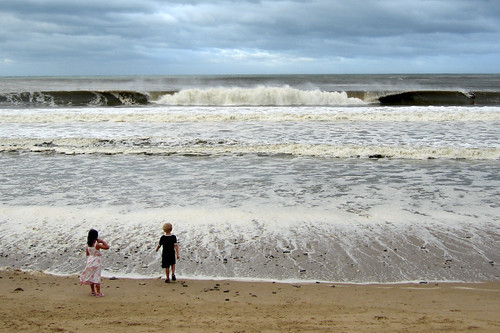
Ever hear of something called a King Tide? Well we've had them this week along the Sunshine Coast. Apparently it's got something to do with the combination of a full moon and strong winds driven by a cyclone in the north. It creates bigger than usual tides and massive waves.
The surfers love them, and even though we're not surfers we love playing in waves too. So we've been in the water a couple of times. Today we went to Sunshine Beach, which is just a few minutes up the coast and is the nearest patrolled beach. (Castaways Beach itself is just a few minutes walk from our house, but it's not patrolled. And everyone -- and I mean every Australian I've ever spoken to -- has told us not to swim on an unpatrolled beach. People die, every year, from swimming on unpatrolled beaches, where there's nobody to save you when you get caught in a rip tide. We take these warnings seriously, so we look for the lifesavers and their flags.)
Anyway, today we went to Sunshine Beach to play in the waves. It was great fun, for the first hour or so. We took turns riding body boards and body surfing. The waves seemed about two metres high and were stacked one on top of the other. The sea going back out was sometimes as powerful as the waves coming in, and just as capable of knocking you down. The beach was open, but the lifesavers were warning people not to go deeper than waist deep.
By the end of it, we were all buffeted, bruised, sand-whipped and salt-filled. It gave us a whole new appreciation for the power of the ocean. Tonight we read in the local paper that the lifesavers at Noosa's main beach performed about 20 rescues over the weekend.
This photo was taken at another beach in the area a couple of years ago, but it's a pretty good representation of what we saw today.
Tuesday, January 13, 2009
The weird world of vegemite. And more on coffee.
Forget religion, politics or sport. The thing that really defines a people is their attitude toward particular foods. After two weeks in this country, coffee continues to confound us: while restaurants typically serve capuccinos, lattes and the like, in their homes it seems most people drink instant coffee. I suspected as much by visiting the grocery stores, where the coffee selection is typically split between espresso and instant.
It's quite good instant coffee, but it's difficult to explain to Australians the deep-seated prejudice many Canadians have against instant. In Canada, instant is the coffee you drink if you can't find anything else, suitable for camping, particularly rustic cottages, and rather run-down workplaces, but really not something you would choose to drink every day. To have instant coffee topped with professionally-frothed milk and a dusting of chocolate sugar is nothing less than bizarre. Still, as I said, it is very good instant, and I can quickly get used to it.
Stocking up on food is another area where we seem to differ. It's not difficult to see why: Canadians come from a culture in which you have a few months to grow and store the food that will get you through the winter. We're only a couple of generations removed from the time when a pantry full of canned foods, a root cellar full of potatoes and turnips, and a few smoked hams hanging in the attic were signs that it was going to be a good winter. Even though we can now buy "fresh" strawberries trucked in from Florida in February, most of us still keep a few weeks of food on hand in our pantries and freezers. Australians, from what I've seen, don't seem to do that. When farmers bring in the summer crop, that just means it's time to start growing the winter crop. The one exception, I've been told, is in the northern areas where they have a pronounced wet season, and people stock up to ensure they've got enough food in case they get cut off by floods.
Then there's Vegemite. It's a complex part of the Australian psychology, more myth than food. Foreigners don't like it, and aren't expected to. The ability to eat and enjoy vegemite is a defining national characteristic. I really can't come up with an analagous custom from Canada. Our national foods are things like donuts, butter tarts and poutine, foods which are easy to enjoy; we haven't taken dishes like seal flipper pie or prairie oysters and made them into national icons. Our most iconic trait is winter: we take pride in our ability to withstand the cold, and relish hearing others complain about it, but the analogy doesn't hold since most of us don't really enjoy winter the way Australians enjoy vegemite. After all, when we go on holiday in winter we usually go somewhere warm; when Australians go on holiday, they take a jar of vegemite with them. (In fact, it's now available in tubes just to cater to travelling Aussies who don't want to risk having a glass jar burst in their luggage).
Other Australian dishes are much easier to like. Their meat pies are fantastic (there are pie shops in many towns), we were already fans of pavlova and Australian wines, and the beer is excellent. We've had store-bought lamingtons (sponge cake covered in thin icing and rolled in coconut), and been underwhelmed, but I'm told we really need to get homemade lamingtons to fully appreciate them. I'm looking forward to trying kangaroo, "bugs" (lobster-like sea critters), more seafood, and various types of "bush tucker". But Vegemite is going to take some more getting used to.
It's quite good instant coffee, but it's difficult to explain to Australians the deep-seated prejudice many Canadians have against instant. In Canada, instant is the coffee you drink if you can't find anything else, suitable for camping, particularly rustic cottages, and rather run-down workplaces, but really not something you would choose to drink every day. To have instant coffee topped with professionally-frothed milk and a dusting of chocolate sugar is nothing less than bizarre. Still, as I said, it is very good instant, and I can quickly get used to it.
Stocking up on food is another area where we seem to differ. It's not difficult to see why: Canadians come from a culture in which you have a few months to grow and store the food that will get you through the winter. We're only a couple of generations removed from the time when a pantry full of canned foods, a root cellar full of potatoes and turnips, and a few smoked hams hanging in the attic were signs that it was going to be a good winter. Even though we can now buy "fresh" strawberries trucked in from Florida in February, most of us still keep a few weeks of food on hand in our pantries and freezers. Australians, from what I've seen, don't seem to do that. When farmers bring in the summer crop, that just means it's time to start growing the winter crop. The one exception, I've been told, is in the northern areas where they have a pronounced wet season, and people stock up to ensure they've got enough food in case they get cut off by floods.
Then there's Vegemite. It's a complex part of the Australian psychology, more myth than food. Foreigners don't like it, and aren't expected to. The ability to eat and enjoy vegemite is a defining national characteristic. I really can't come up with an analagous custom from Canada. Our national foods are things like donuts, butter tarts and poutine, foods which are easy to enjoy; we haven't taken dishes like seal flipper pie or prairie oysters and made them into national icons. Our most iconic trait is winter: we take pride in our ability to withstand the cold, and relish hearing others complain about it, but the analogy doesn't hold since most of us don't really enjoy winter the way Australians enjoy vegemite. After all, when we go on holiday in winter we usually go somewhere warm; when Australians go on holiday, they take a jar of vegemite with them. (In fact, it's now available in tubes just to cater to travelling Aussies who don't want to risk having a glass jar burst in their luggage).
Other Australian dishes are much easier to like. Their meat pies are fantastic (there are pie shops in many towns), we were already fans of pavlova and Australian wines, and the beer is excellent. We've had store-bought lamingtons (sponge cake covered in thin icing and rolled in coconut), and been underwhelmed, but I'm told we really need to get homemade lamingtons to fully appreciate them. I'm looking forward to trying kangaroo, "bugs" (lobster-like sea critters), more seafood, and various types of "bush tucker". But Vegemite is going to take some more getting used to.
Saturday, January 10, 2009
Noosa: first thoughts
We flew into Maroochidore, which is an interesting experience since the plane comes in low over the water and lands right beside the beach. At one point we wondered if it had to have pontoons since you don't actually see land until you're nearly on it.
The bus brought us right to the door, and we got our first look at our new home. Jacqui and Charlie's house is just as lovely as it appeared in the photos, and the kids were soon upstairs sorting out who got what room. That taken care of, it was in to the pool, something Charlie in particular had been waiting to do for days.
After a quick swim, I got in the car and went to find some "takeaway". (Incidentally, it's quite funny how we're all starting to pick up the lingo. We buy takeaway and stand in a queue without a second thought. I haven't got used to being asked "how're ya goin?" though: I keep wanting to reply "I'm going by car.") I ended up in Peregian Beach, which is just to the south of us. It's a funky little beach village, whose commercial area seems to consist mainly of a square block or so containing half a dozen restaurants, a grocery store, and three bottle shops (liquor stores). It was just after dark, and the square was bustling with families and couples sitting at sidewalk tables and at picnic tables, sharing a meal and watching the kids run around. Very casual, very cool, very fun.
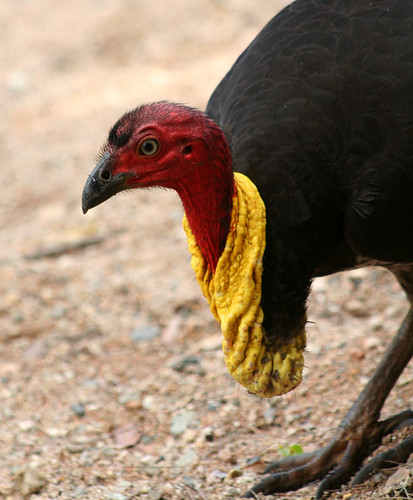
Early to bed last night, as we're still a bit wrung out from the road. Turns out the neighbours are very noisy. Not the human ones, but the birds and frogs. The house backs onto a national park, and after dark the volume of noise from the frogs and insects is insane. It gets even louder around 5:00 when the parrots and other birds start to wake up. Still, it won't be hard to get used to it. This morning, as we had a coffee on the deck, we watched as a bush turkey strutted into the yard (picture is courtesy of Flickr). I said that was all very well and good, but we wouldn't be as thrilled if snakes and crocodiles started coming out to visit us. Sharon says we need a gun -- first to silence the squawky birds, then to shoot a turkey for dinner. A true Muskoka girl, that Sharon.
We took a quick look around Noosa today, but we're still a bit whipped and none of us seem to feel much like doing anything but lounging around the pool. Tomorrow we'll go exploring a bit.
So far Noosa and surrounds reminds me of a mix between Port Carling and Grand Bend -- communities that are home to locals but exist for the tourists. It's very easy to see why Noosa is such a popular vacation destination, and why so many Australians, upon learning we were going to be spending a year here, congratulated us.
As an indication of how renowned Noosa is, in the travel section of yesterday's The Australian newspaper, there was an article on the growing popularity of cruise ships. The lede said "Cruise ships are the new Noosa."
Now it's time for a dip before dinner.
Melbourne in three days
You can't get much more whirlwind than that. We arrived in Melbourne early Wednesday morning after a long, long train ride. Picked up a rental car and began the exciting process of learning to drive on the left while finding our hotel. Then we all slept for a few hours before going for a drive in the afternoon.
We ended up driving to Dandenong National Park, a fabulous landscape of twisting roads and massive trees. Even though the temperature can get almost to freezing here in south Australia, the forest is a rain forest with jurassic-looking ferns the size of trees, and trees that shoot straight up for 30 metres before the first branch appears.
The next day we headed south to the much-hyped Great Ocean Road... and quickly discovered that it is the busiest week of the year for the region. We lucked into a motel room, then set out to drive along the road. It was built after WW1 as a living tribute to the servicemen, and took some 3,000 men with shovels and wheelbarrows to carve this road out of the coastline. It's some of the most amazing scenery in Australia, and we didn't even get to the best part of it. (It was one of those compromises you make when travelling with kids -- Sharon and I could have spent all day going happily from lookout to lookout, but after a few hours the kids felt they were all starting to look the same.) So we stopped at a beach and watched the surfers and kite-flyers, and ran in the wind and sand, and marvelled at the fact that the next land out to sea from us was Antarctica. (We weren't sure if Tasmania was in the way, but decided we could probably skirt around it in our imaginary voyage. Sorry Tasmania.)
On the way back to the motel, we drove past a golf course we'd been told about: kangaroos! Dozens of them, staring at us and thinking we look just as odd as they do. You can't help but look at them and wonder how they must have appeared to the first Europeans to arrive here. They look freaky enough to us.
On the road again on Friday, hoping to get to Phillip Island to see the penguin parade. Our hopes weren't high as we hadn't found a place to stay by mid-afternoon, but we lucked out in a place called Frankston. It was a little over an hour from Phillip Island, but we knew that was as close as we were going to get.
We were a little apprehensive heading to the island, as we'd been told it was overdeveloped and commercialized, with bleachers on the beach to watch the penguins. Turns out there are bleachers, but with good reason: before they were built, people would just drive down to the beach, often running over penguins or crushing burrows on their way. Now it's a serious ecotourism operation, where the penguins come first. You're not even allowed to take photos, for fear you'll frighten the birds.
We took a tour of the site with a ranger, then headed down to the beach to wait for dusk. It was FREEZING! About 10 degrees with a fierce wind whipping off the ocean (all the way from Antarctica, remember). But around 9:00, we started to see the first of the penguins come ashore. Then more and more came, in groups of six to twenty, wading out of the surf, looking around for predators, dashing back in, then eventually making their way across the beach to the dunes where their chicks were waiting in the dens. By walking along the boardwalks through the dunes we could get within a couple of feet of these penguins, listening to them chatter to their chicks and discussing the day's events. It was a real highlight of the trip for all of us.
A great way to end our perigrinations. The next day, Saturday, we returned the car and hopped on a plane. Tonight we arrived in Noosa at last.
We ended up driving to Dandenong National Park, a fabulous landscape of twisting roads and massive trees. Even though the temperature can get almost to freezing here in south Australia, the forest is a rain forest with jurassic-looking ferns the size of trees, and trees that shoot straight up for 30 metres before the first branch appears.
The next day we headed south to the much-hyped Great Ocean Road... and quickly discovered that it is the busiest week of the year for the region. We lucked into a motel room, then set out to drive along the road. It was built after WW1 as a living tribute to the servicemen, and took some 3,000 men with shovels and wheelbarrows to carve this road out of the coastline. It's some of the most amazing scenery in Australia, and we didn't even get to the best part of it. (It was one of those compromises you make when travelling with kids -- Sharon and I could have spent all day going happily from lookout to lookout, but after a few hours the kids felt they were all starting to look the same.) So we stopped at a beach and watched the surfers and kite-flyers, and ran in the wind and sand, and marvelled at the fact that the next land out to sea from us was Antarctica. (We weren't sure if Tasmania was in the way, but decided we could probably skirt around it in our imaginary voyage. Sorry Tasmania.)
On the way back to the motel, we drove past a golf course we'd been told about: kangaroos! Dozens of them, staring at us and thinking we look just as odd as they do. You can't help but look at them and wonder how they must have appeared to the first Europeans to arrive here. They look freaky enough to us.
On the road again on Friday, hoping to get to Phillip Island to see the penguin parade. Our hopes weren't high as we hadn't found a place to stay by mid-afternoon, but we lucked out in a place called Frankston. It was a little over an hour from Phillip Island, but we knew that was as close as we were going to get.
We were a little apprehensive heading to the island, as we'd been told it was overdeveloped and commercialized, with bleachers on the beach to watch the penguins. Turns out there are bleachers, but with good reason: before they were built, people would just drive down to the beach, often running over penguins or crushing burrows on their way. Now it's a serious ecotourism operation, where the penguins come first. You're not even allowed to take photos, for fear you'll frighten the birds.
We took a tour of the site with a ranger, then headed down to the beach to wait for dusk. It was FREEZING! About 10 degrees with a fierce wind whipping off the ocean (all the way from Antarctica, remember). But around 9:00, we started to see the first of the penguins come ashore. Then more and more came, in groups of six to twenty, wading out of the surf, looking around for predators, dashing back in, then eventually making their way across the beach to the dunes where their chicks were waiting in the dens. By walking along the boardwalks through the dunes we could get within a couple of feet of these penguins, listening to them chatter to their chicks and discussing the day's events. It was a real highlight of the trip for all of us.
A great way to end our perigrinations. The next day, Saturday, we returned the car and hopped on a plane. Tonight we arrived in Noosa at last.
Tuesday, January 6, 2009
Sydney
You know how everything you read about Sydney goes on about the beautiful harbour and the stunning architecture of the opera house? Well it turns out to be fully justified. It isn't until you travel through the harbour that you really realize how big and how beautiful it is. And the opera house is truly a remarkable building, lovely from every angle.
A few other random observations about Sydney, and the bit of Australia we've seen so far:
The Aquarium is world class. Unfortunately, it knows it. Admission is pricey, refreshments are exorbitant, and on a weekend in January the crowds are nearly impenetrable. Not a high point of the trip.
The Olympic site is absolutely massive. Really drives home what an enormous undertaking the Olympics really are. I took the younger two children for a swim, and we spent hours playing in the wonderful new splash pool at the aquatic centre.
Australians warned me that we couldn't get Tim Hortons here. No worries, I thought --I find Tims to be over-rated anyway. What they didn't tell me is that you can't get regular coffee here at all! You can get very good lattes, espressos, mochas, etc at every turn, but a plain coffee with milk? Forget it.
Parramatta, by the way, has the largest concentration of coffee shops on the planet. It's the suburb of Sydney that we stayed in. No word of a lie, in a one block stretch of road beside our hotel there were eight coffee shops.
We had expected Bondi to be overcrowded, overpriced, and over-rated . It wasn't any of them. Yes, it was very busy, but it was a great beach, and the town itself has that funky, fun vibe that you find in all well-used beach towns, combined with a rolling, higgledy-piggledy road system that had me glad I was riding a bus. Think Wasaga Beach meets Quebec City with a slightly faded 1920s facade.
The Blue Mountains are absolutely stunning. We did a day trip from Parramatta (1.5 hours on the train each way, with a hop-on hop-off bus pass to get around the towns of Katoomba and Leura). Breathtaking scenery, and a fantastic hike through the rain forest.
City Rail is the best value for families. The trains are clean and on time, and right now you only pay for the first child in a family. We have hardly missed a car at all in our time in Sydney.
Now we leave Sydney behind, and take the night train to Melbourne. (It was supposed to be the day train earlier today, but that fell victim to the Murphy's Law that seems to be our constant travelling companion these days.) Just a short trip to Melbourne, then we fly up to our new home on Saturday.
A few other random observations about Sydney, and the bit of Australia we've seen so far:
The Aquarium is world class. Unfortunately, it knows it. Admission is pricey, refreshments are exorbitant, and on a weekend in January the crowds are nearly impenetrable. Not a high point of the trip.
The Olympic site is absolutely massive. Really drives home what an enormous undertaking the Olympics really are. I took the younger two children for a swim, and we spent hours playing in the wonderful new splash pool at the aquatic centre.
Australians warned me that we couldn't get Tim Hortons here. No worries, I thought --I find Tims to be over-rated anyway. What they didn't tell me is that you can't get regular coffee here at all! You can get very good lattes, espressos, mochas, etc at every turn, but a plain coffee with milk? Forget it.
Parramatta, by the way, has the largest concentration of coffee shops on the planet. It's the suburb of Sydney that we stayed in. No word of a lie, in a one block stretch of road beside our hotel there were eight coffee shops.
We had expected Bondi to be overcrowded, overpriced, and over-rated . It wasn't any of them. Yes, it was very busy, but it was a great beach, and the town itself has that funky, fun vibe that you find in all well-used beach towns, combined with a rolling, higgledy-piggledy road system that had me glad I was riding a bus. Think Wasaga Beach meets Quebec City with a slightly faded 1920s facade.
The Blue Mountains are absolutely stunning. We did a day trip from Parramatta (1.5 hours on the train each way, with a hop-on hop-off bus pass to get around the towns of Katoomba and Leura). Breathtaking scenery, and a fantastic hike through the rain forest.
City Rail is the best value for families. The trains are clean and on time, and right now you only pay for the first child in a family. We have hardly missed a car at all in our time in Sydney.
Now we leave Sydney behind, and take the night train to Melbourne. (It was supposed to be the day train earlier today, but that fell victim to the Murphy's Law that seems to be our constant travelling companion these days.) Just a short trip to Melbourne, then we fly up to our new home on Saturday.
Friday, January 2, 2009
Three countries later...
We got on the Dec 29 flight to LA, a tight-as-sardines excursion that landed at LAX on time. We still came very, very close to missing our next connection as we changed terminals and went through security. With seconds to spare (the ticket agent was literally shutting down the flight as we arrived at the gate) we got on board our Air Pacific 747, en route to Fiji at last. The flight was long, but not unbearable, and the staff of Air Pacific were wonderful. I'd definitely fly with them again.
We landed in Fiji on Dec 31. Our luggage, however, hadn't made the same sprint between planes and was reportedly still in LA. No worries, though, as we had been warned this might happen and had packed our toothbrushes and bathing suits in our carry-on bags.
Fiji is a beautiful country, and the people are incredibly friendly. We went shopping in Latoka, the second largest town on the island, and spent all afternoon replying to strangers who greeted us with a friendly Bula. (it means hello. That and vinaka, or thank-you, sums up my knowlege of Fijian.)
The new year's eve party was a bit of a bust, as we all fell asleep by about 10, but we toasted the new year on Canadian time the next afternoon.
After 28 hours in Fiji, we collected our bags (5 of the 6 missing suitcases showed up on the next flight from LA; the sixth is still MIA), bought a bottle of Bounty rum at the duty free, and hopped on yet another plane. Next stop, Sydney.
We landed in Fiji on Dec 31. Our luggage, however, hadn't made the same sprint between planes and was reportedly still in LA. No worries, though, as we had been warned this might happen and had packed our toothbrushes and bathing suits in our carry-on bags.
Fiji is a beautiful country, and the people are incredibly friendly. We went shopping in Latoka, the second largest town on the island, and spent all afternoon replying to strangers who greeted us with a friendly Bula. (it means hello. That and vinaka, or thank-you, sums up my knowlege of Fijian.)
The new year's eve party was a bit of a bust, as we all fell asleep by about 10, but we toasted the new year on Canadian time the next afternoon.
After 28 hours in Fiji, we collected our bags (5 of the 6 missing suitcases showed up on the next flight from LA; the sixth is still MIA), bought a bottle of Bounty rum at the duty free, and hopped on yet another plane. Next stop, Sydney.
Subscribe to:
Posts (Atom)
